

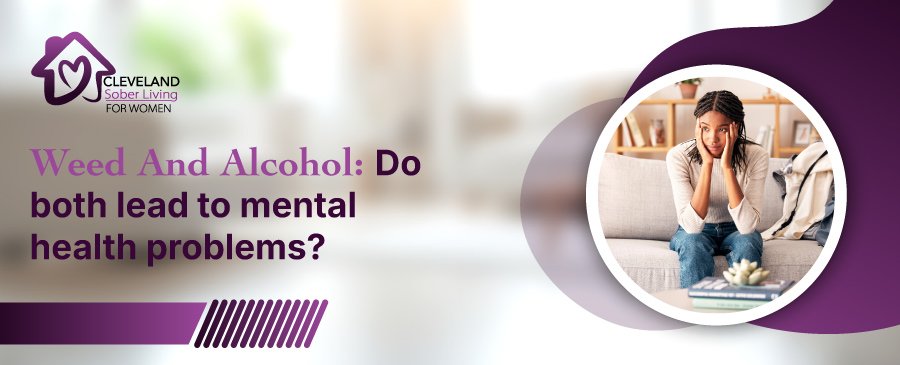
Weed And Alcohol: Do both lead to mental health problems?
Weed and alcohol both contain psychoactive compounds. These compounds interact with neurotransmitters, altering your mood and brain.
In case of alcohol, ethanol and water are the main components, and ethanol contains psychoactive compounds. As long as weed (cannabis) is considered, it contains certain psychoactive compounds, with THC (Tetrahydrocannabinol) and CBD (cannabidiol) as the primary ones. Thus, both carry long term dependency risks.
Furthermore, THC is mainly responsible for affecting mood and brain. This may be the reason behind why CBD, containing less than 0.5% of THC, is legal in the USA (under federal law).
Looking for a women’s behavioral health center in Ohio? Cleveland Sober Living for Women offers specialized sober living programs designed for women ready to reclaim their sobriety and their lives..
How Cannabis and Alcohol Affect Your Brain
None among weed and alcohol affect your brain positively. Some studies suggest that the overall effects of alcohol are worse compared to those of weed (cannabis) though.
Cannabis (THC): It activates cannabinoid receptors – areas of the brain controlling memory, mood, pleasure, and executive function. THC is a partial activator of these receptors. Natural cannabis also contains CBD, a compound that has a calming, protective effect and helps dampen some of THC’s more adverse effects.
Alcohol: It enhances GABA – the brain’s primary “slow down” signal – while simultaneously blocking glutamate, the brain’s “speed up” signal. The net effect is a suppression of brain activity. This is the same basic mechanism as prescription tranquilisers like Valium.
Simultaneous Use of Weed and Alcohol:
According to a study shared by NCBI, the primary difference in the effects of alcohol and cannabis during simultaneous use is that alcohol product variety is a stronger driver of acute behavioral consequences, while cannabis product choice primarily influences consumption quantity. The research found that mixing multiple alcohol products on the same day consistently increased the odds of negative outcomes, such as blackouts and heavier drinking, whereas using cannabis concentrates or multiple cannabis products primarily led to higher levels of consumption without significantly increasing the specific acute consequences measured. Furthermore, the study cites laboratory evidence indicating that the combined use of these substances produces additive or synergistic effects on the brain, resulting in significantly greater cognitive impairment and higher subjective intoxication ratings than the use of either substance in isolation.
Thus, while alcohol variety poses a more immediate risk for behavioral harm, cannabis variety predominantly impacts the total dose of the drug processed by the brain.
Weed and Alcohol Comparison
| Feature | 🌿 Cannabis (THC) | 🍺 Alcohol |
|---|---|---|
| How it works | Partially activates cannabinoid receptors in areas governing memory, mood, and pleasure | Enhances the brain's "calm down" signal (GABA) and suppresses the "speed up" signal (glutamate) |
| Desired effects | Relaxation, euphoria, heightened senses, calm | Reduced inhibition, relaxation, social ease |
| Adverse mood effects | Anxiety and paranoia — especially at high doses or in first-time users | Aggression, emotional volatility, low mood during and after heavy use |
| Psychosis risk | Can cause or worsen psychotic symptoms, particularly in those with a predisposition or family history | Heavy or chronic use can cause alcohol-induced psychotic disorder — including hallucinations and paranoid delusions — though this typically resolves with abstinence |
| Anxiety & paranoia | Well-documented short-term effects at higher doses. CBD in natural cannabis helps dampen this effect | Initially reduces anxiety, but causes rebound anxiety as it wears off — commonly known as "hangxiety" |
| Cognitive effects | Impairs short-term memory and concentration during use. Long-term heavy use — especially starting in adolescence — linked to lasting cognitive deficits and executive function problems | Impairs judgement and memory acutely. Long-term heavy use can cause significant cognitive decline and, in severe cases, Wernicke-Korsakoff syndrome — a serious and debilitating brain disorder |
| Dependency type | Primarily psychological — not traditionally physically addictive | Both physical and psychological. Alcohol dependency is considered more severe and more dangerous to stop without help |
| Withdrawal | Irritability, sleep disruption, reduced appetite. Not medically dangerous | Can be medically dangerous: tremors, seizures, and delirium (delirium tremens). Requires medical supervision in serious cases |
| Depression link | Regular heavy use associated with depressive symptoms. Causality is debated — some people may use cannabis to self-medicate depression | Strongly associated with depression. Alcohol is a depressant — it lowers serotonin and dopamine over time. Chronic use significantly raises depression and suicide risk |
| Young people | The developing brain is especially vulnerable. Early use associated with white matter abnormalities and long-term vulnerability to psychosis | Early use damages the developing brain, impairs memory formation, and raises lifetime risk of alcohol use disorder |
Key Differences at a Glance
Withdrawal danger: Stopping alcohol suddenly after heavy use can be life-threatening — causing seizures and delirium. Whereas, cannabis withdrawal is uncomfortable but not medically dangerous.
Psychosis: Both can trigger psychotic episodes. Cannabis-linked psychosis can persist even after stopping. Alcohol-induced psychosis more commonly resolves with abstinence.
Dependency: Alcohol creates physical dependency; cannabis typically creates psychological dependency. Both are real and can seriously affect a person’s life.
Young people: Both carry significant risk during adolescent brain development. Neither is safe for young people.
Depression: Alcohol is a central nervous system depressant, hence has a more direct and consistent link to depression over time. The cannabis-depression relationship is more complex and debated.
The Bottom Line
Neither substance is without risk to mental health. The key differences are in how they harm: alcohol carries a higher risk of dangerous physical withdrawal and a more direct pathway to depression, while cannabis carries a higher risk of triggering or worsening psychosis in vulnerable individuals. Both are particularly harmful to young people whose brains are still developing.
Frequently Asked Questions
Some scientific societies are of the view that men should restrict their alcohol to 2 drinks or less, while women should not exceed 1 drink (14 g of ethanol) a day.
In contrast, according to the World Health Organization, no level of alcohol is safe for your health. WHO says that a safe level would be the one under which alcohol will cause no harm, and no such threshold is backed by scientific evidence.
According to a survey, marijuana, commonly called weed, is generally considered only mildly addictive with only about 5% of the U.S. population has ever been dependent on it, compared to nearly 14% for alcohol and 36% for tobacco.
Mental health and substance use disorders fall under behavioral health, and centers treating these issues are called behavioral health centers.

Your Life
Belongs to You
Schedule Your Consultation
Our Latest
Blogs